
The short version
What does the percentage tell you?
An availability percentage describes a service commitment over a defined period. A 100% commitment is stronger than 99.995% when the measurement and terms are otherwise the same. Neither number, by itself, explains how a provider will restore service after a fiber cut.
To compare proposals, read the measurement and remedies alongside the operational plan: who responds, who can work on the damaged network, and how access and emergency construction are coordinated. The guide to understanding your Internet SLA explains the broader terms; this guide follows the work after an interruption. [1]
01 / Availability
99.995% and 100% measure different thresholds
For illustration, assume a continuously measured 30-day month, with every minute of interruption included. Thirty days contain 43,200 minutes. The unavailable portion of 99.995% is 0.005%, or 2 minutes and 9.6 seconds. At 100%, the corresponding amount is zero.
| Availability | Corresponding counted downtime |
|---|---|
| 99.995% | 2 minutes, 9.6 seconds |
| 100% | Zero |
These figures are arithmetic, not predicted outages or a promise that service will never be interrupted. An agreement may use a different period, measurement boundary, minimum event duration or exclusions. Compare those definitions before assuming two published percentages cover the same events. [1]
For perspective, one four-hour interruption in that illustrative month would leave about 99.44% availability if every minute counted. Whether it qualifies for an SLA remedy depends on the actual agreement.
Engineering and reality
Is 100% uptime realistic?
A connection can achieve 100% measured availability over a particular month, and a provider can offer 100% as a contractual commitment. Neither establishes that a connection will never experience an interruption. Expecting a physical network to operate without interruption in every circumstance, forever, is not realistic. The meaningful question is how the service is engineered, operated and measured—and what the agreement says happens if the commitment is not met.
An availability objective should be grounded in the network design and operating plan. Diverse routes, independent equipment and power, monitoring, maintenance procedures and tested failover can reduce the chance that a single fault interrupts a customer. Whether they work depends on the actual service and its shared dependencies; two paths can still meet at the same building entrance, splice location or customer device. Ask the provider to explain which failures the design can withstand and which ones would still interrupt your connection.
Real networks face events that cannot be eliminated entirely:
- Fiber cuts: construction, utility work or other damage can interrupt a cable. Restoration may require access, splicing and testing.
- Splice-closure damage: a fiber optic splice closure (FOSC) is a protective enclosure where fiber strands are joined. Damage to the enclosure or the fiber inside it can affect the circuits passing through that location. [8]
- Splice-closure maintenance: Technicians may open a FOSC during planned maintenance or other work to inspect its gaskets and seals, and clean the closure interior and sealing surfaces as appropriate before resealing it. Handling fibers already in service can introduce bends, strain or accidental damage that interrupts affected circuits. Procedures and inspection intervals depend on the closure, its environment and the operator’s maintenance plan; not every closure needs routine opening. Manufacturers provide model-specific instructions for protecting fibers and inspecting and cleaning seals. [10]
- Router maintenance: hardware replacements and software upgrades can interrupt forwarding if traffic cannot be moved safely to another path.
- Routing interruptions: Border Gateway Protocol (BGP) is one of the systems networks use to exchange routing information. A session or routing change can cause packet loss or temporary unreachability while networks adjust. Planned traffic-draining procedures and a suitable alternate path can reduce or sometimes prevent that loss; they are not a blanket guarantee. [9]
A fault does not automatically become an outage for every customer: protection can keep traffic flowing. Conversely, a customer may experience disruption that an SLA measures differently or excludes. Compare the engineering design and the customer’s experience with the written definitions, measurement boundaries, exclusions and remedies.
02 / The clocks
Response, dispatch and restoration are separate events
A support acknowledgment tells you when a report was received or answered. Dispatch starts the process of sending people; arrival at the site is a separate event. Restoration is when the affected service is working again under the agreement’s definition. A temporary reroute may restore traffic before permanent physical repairs are complete.
Mean time to repair, or MTTR, needs a definition too. Ask whether a figure is an average, an operational target or a contractual per-incident commitment; what starts and stops the clock; which incidents are included; and how excluded time is handled. A four-hour average does not mean every repair takes at most four hours. [7]
For example, four illustrative repairs lasting one, one, one and thirteen hours average four hours, even though the longest took thirteen. If the risk of a long interruption matters, ask for the distribution of actual restoration times and how often incidents exceed the stated target—not only an average.
03 / The work
What happens after a fiber is damaged?
The sequence depends on the fault and the route, but a useful discussion can follow the incident from the customer’s report to verified recovery:
- Detect and locate. Monitoring and troubleshooting help establish which services are affected and where the fault may be.
- Dispatch and access. The provider assigns qualified people, equipment and a route to the suspected location, and coordinates building or street access as needed.
- Make the site safe. The team determines the work required and coordinates applicable safety, utility-location and authorization requirements.
- Restore the connection. Depending on the incident, teams may reroute traffic or access, replace and splice damaged fiber.
- Test and confirm. The provider verifies the connection at the appropriate handoffs, communicates status and completes any remaining restoration work.
Steps may overlap, and a damaged cable may be in a building, a conduit, an aerial route or another location. A worksite controlled by another party or emergency responders can affect access. The details are specific to the incident.

04 / People and equipment
Who can actually perform the repair?
Network ownership and field capability are related, but they answer different questions. A provider may own some or all of a route, operate equipment on another network, employ its own technicians, use specialist contractors, or combine these models. Ask about the specific connection and the work required for it.
Find out who can diagnose and splice fiber, who performs excavation and pavement restoration when needed, where crews and equipment are based, and who can dispatch them outside business hours. Ask which steps depend on another company and who coordinates the response. An in-house team can reduce coordination handoffs; its presence alone does not guarantee a particular repair time.
05 / Emergency street work
When the route is beneath a street
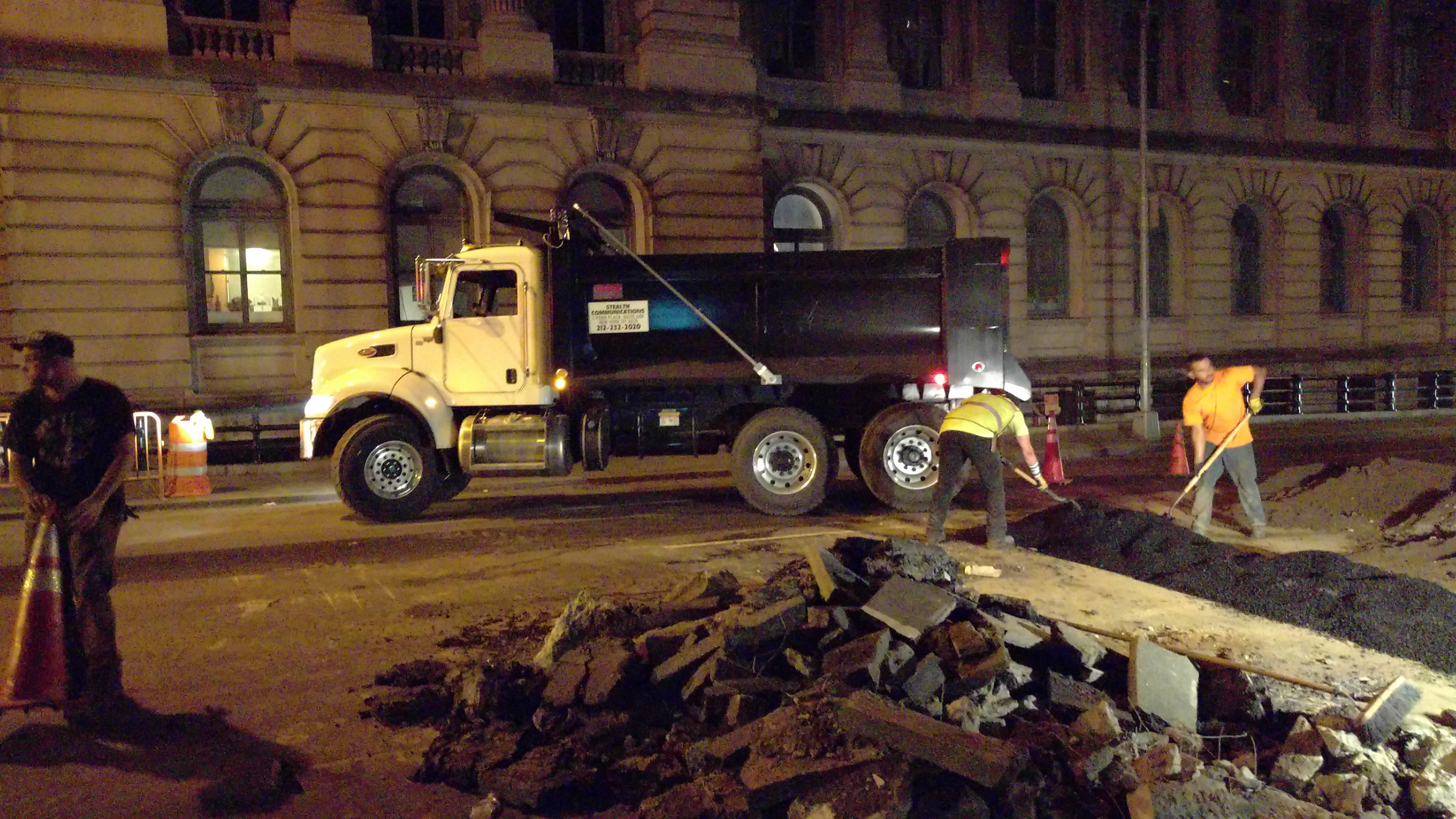
Not every fiber repair requires excavation. When a qualifying emergency repair does require opening a New York City street, the responsible party must follow the applicable emergency authorization process and worksite requirements. NYC DOT’s Street Works Manual describes the emergency street-opening number and subsequent permit process. [4]
For qualifying repairs to active cables that are down, Stealth’s experience is that the city can grant emergency street-opening authorization within a few minutes of an application. The decision and timing remain subject to city approval and the circumstances. Authorization is not the same as site access, a completed excavation or restored service.
Ask a provider who is registered and prepared to request the authorization, who will perform excavation if required, and how utility coordination and safety are handled. Permission to open a street does not remove the need to follow the applicable conditions or protect other underground infrastructure. [4]
06 / The agreement
What does the SLA cover, and what is the remedy?
Look for the covered service and endpoints; how unavailability is measured; whether intermittent failures count; and when the incident clock begins. Review maintenance, customer equipment, outside networks, third-party damage and force-majeure terms. Different agreements can treat the same incident differently.
Then read the remedy: whether a credit must be requested, its calculation and cap, notification deadlines, and any cancellation rights. A credit can address a qualifying contractual failure, but it does not itself recover lost business time. Keep the incident reference and your own timestamps.
Apply the same questions to Stealth’s proposal. Its published terms define downtime, credits and exclusions; the signed service order and applicable terms determine what applies to a particular customer. [5]
07 / Continuity
Plan for the outage you cannot wait through
Even a strong restoration plan cannot eliminate every disruption. Decide which systems must keep working and how long your organization can operate without each connection.
If using a backup, ask whether it shares the primary service’s building entrance, conduit, equipment, power or upstream route. Two connections may still share a physical point of failure. Agree on how traffic will switch, test the failover and check that the backup has enough capacity for essential work. [6]
08 / Compare proposals
Questions to ask each provider
- Which circuit, endpoints and events are included in the availability calculation?
- When does the response clock start, and what constitutes dispatch, arrival and restoration?
- Is the repair figure a mean, a target or a per-incident commitment? Can you share its measurement method and distribution?
- Who owns and maintains the physical route to our handoff?
- Who is available around the clock to locate, splice and repair a cut? Which people are employees and which are contractors?
- Who can request emergency street-opening authorization, and who performs excavation if it is needed?
- What access, utility, safety or third-party dependencies could affect this route?
- Which exclusions, credits, caps and notice requirements apply to our agreement?
- How independent is our backup path, and when did we last test failover?
Ask each provider the same questions for the same location and service. A useful proposal should make both the contractual commitment and the restoration responsibilities understandable.
About this guide
References
- [1] Stealth Communications — Understanding your Internet SLA
Availability, measurement boundaries, exclusions and remedies.
- [2] Stealth Communications — Our network
Stealth’s network, construction crews and network operations.
Return to citation: A - [3] Stealth Communications — Support FAQ
Published information on field teams and support.
Return to citation: A - [4] NYC DOT Street Works Manual — Emergency work
Emergency street-opening authorization and permit procedures.
- [5] Stealth Communications — Terms of service
Published service terms, definitions, exclusions and remedies; applicable signed documents govern.
Return to citation: A - [6] Stealth Communications — Internet redundancy
Shared physical risks and failover planning.
Return to citation: A - [7] NIST SP 800-55 Volume 1 — Measurement Guide for Information Security
Mean-time measures and the importance of understanding their underlying data.
Return to citation: A - [8] ITU-T L.110 — Optical fiber cable engineering
Engineering considerations including protection of optical fiber and splice closures.
Return to citation: A - [9] IETF RFC 8326 — Graceful BGP Session Shutdown
Procedures for reducing traffic loss during planned routing maintenance.
Return to citation: A - [10] CommScope — FOSC 400 installation instructions
Model-specific guidance for fiber handling, sealing-surface cleaning and inspection.
Return to citation: A
Prepared by Stealth Communications, a provider of business connectivity. This guide is educational. Service commitments and remedies depend on the applicable signed agreement and service order.